WEBINAR: Rise with SHAPE Asia: Youth Leading Change in Food Marketing
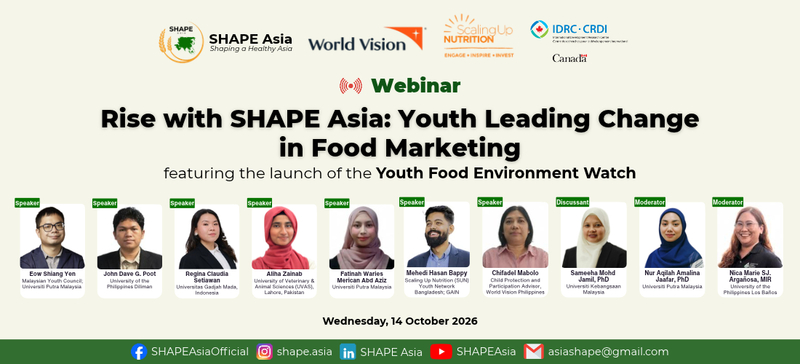
Food marketing shapes what young people see, think, and choose every day. It reaches them through social media feeds, delivery apps, school canteens, checkout counters, and public spaces. The foods promoted most heavily are often high in sugar, salt, and fat.
On 14 October 2026, SHAPE Asia convened Rise with SHAPE Asia: Youth Leading Change in Food Marketing in collaboration with World Vision Philippines and the Scaling Up Nutrition (SUN) Movement. Dr. Nur Aqilah Amalina Jaafar of Universiti Putra Malaysia and Nica Marie SJ. Argañosa, MIR, of the University of the Philippines Los Baños moderated the discussion. The webinar brought together young people, researchers, advocates, and public health partners from across the region. It also marked the launch of the Youth Food Environment Watch, a youth-led initiative under the Rise with SHAPE Asia campaign.
In her opening remarks, Dr. Elaine Q. Borazon, SHAPE Asia Lead and Professor at National Sun Yat-sen University, set the tone for the day. She noted that SHAPE Asia's work turns evidence on food environments into policy action. Yet the people who see these environments most clearly every day are often the least consulted, and those people are young people. "We cannot simply tell young people to make better choices," she said. "We have to make better choices possible." The webinar was designed to do something different. It was not a space to talk about youth, but a space to listen to them.
Marketing that does not look like marketing
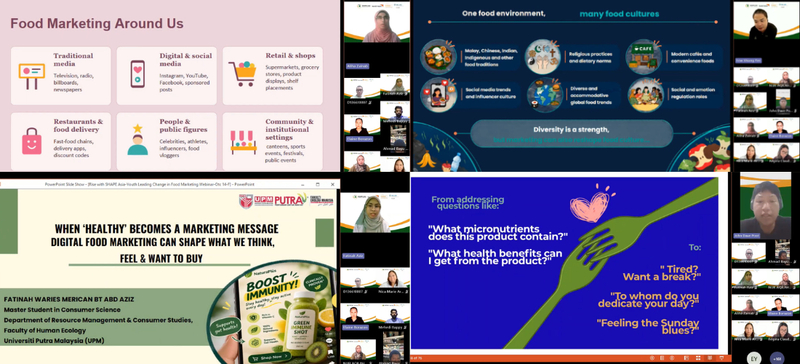
That listening began with a live poll. Participants said they see food marketing most often on social media, followed by delivery apps and public spaces. Youth speakers from Malaysia, the Philippines, Indonesia, and Pakistan then shared what lies behind those answers. One theme stood out. The most powerful marketing rarely looks like marketing at all. Aliha Zainab, a SHAPE Asia Youth Ambassador from Pakistan, described how brands have woven themselves into hospitality, celebrations, and national sport. "Nobody tells us it's being sold to us," she said. John Dave G. Poot of the University of the Philippines Diliman showed how advertising sells stories, not nutrients. A cup of instant noodles on a rainy day becomes comfort and home. The challenge, he noted, is telling a genuine emotional connection apart from one engineered to drive consumption.
When "healthy" becomes the sales pitch
If emotion is one way marketing blends into daily life, health is another. Regina Claudia Setiawan of Universitas Gadjah Mada asked whether products labeled "organic," "natural," or "clean" are truly healthier or simply better marketed. Fatinah Waries Merican Abd Aziz of Universiti Putra Malaysia shared research on foods and drinks promoted online with claims to lower blood pressure or support heart health. Malaysian regulations do not allow such claims. Her study found that high food literacy, on its own, was not linked to young people's intention to buy these products. Knowledge matters, but it is not enough when the environment is built to persuade.
Not about blame, but about balance
This finding points to a deeper truth. If knowing more is not enough, the problem cannot rest on individual choice alone. Speakers were careful not to frame the issue as good food versus bad food. Eow Shiang Yen of the Malaysian Youth Council cautioned against assuming that local food is automatically healthy or global food automatically unhealthy. Food culture today is not only inherited. It is also marketed. The real question is who shapes what young people want to eat, and why. Young people did not ask to be told what to eat. They asked for healthier options that are affordable, culturally meaningful, and easy to choose, along with product information they can trust.
Moving from awareness to action
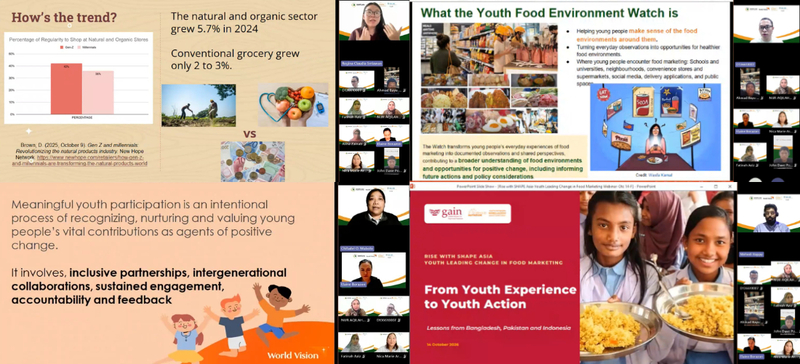
Recognizing these forces is only the first step. The next is acting on them, and young people are already doing so. Mehedi Hasan Bappy of the SUN Youth Network Bangladesh and GAIN shared how youth have led healthy snack campaigns, set up nutritious school canteens, and launched healthy food ventures on campuses. They have also brought these experiences into policy discussions. For such action to last, however, participation must be done right. Chifadel Mabolo of World Vision Philippines reminded participants that youth engagement must be safe, inclusive, and meaningful, never tokenistic. Young people want more than a seat at the table. They want their voices to shape decisions.
What this means for policy
Those decisions are where youth voices can have the greatest impact. Dr. Sameeha Mohd Jamil of Universiti Kebangsaan Malaysia drew the threads together. She called for stronger regulation of food marketing, including misleading health claims. She also called for healthier food environments in schools and communities, better food and digital literacy, and a real role for young people in monitoring marketing. Her central message reflects SHAPE Asia's mission. Responsibility should shift from expecting individuals to resist their environment toward building environments that make healthier choices the easier ones.
Introducing the Youth Food Environment Watch
The Youth Food Environment Watch is SHAPE Asia's answer to that call. It invites young people across Asia to observe, document, and reflect on food marketing in digital, school, retail, and community settings. Over three thematic months, their observations will inform youth-led campaign outputs and advocacy messages. Safety comes first. Participation is guided by informed consent, data protection, and no confrontation or public identification. Young people take part not only as data collectors but as co-designers and co-communicators of the findings.Young people are often treated as targets of food marketing. Through the Watch, they become its observers, its critics, and its changemakers. Explore the Guideline and Information Sheet at https://bit.ly/watchshapeasia and watch the full webinar recording on YouTube at https://youtu.be/R5_PmTCnwag.